Wonky Mugs and Fiver Lamps: A Field Guide to Car Boot Taste
There is a particular smell to a car boot sale in November. Wet grass, diesel, a fry-up van doing steady business, and the faint cardboard tang of somebody's garage finally being emptied. It is 7:40 in the morning, the light is that flat, unpromising grey, and I am crouched over a blanket on the ground, holding a stoneware jug that somebody's nan probably kept dripping plants in. It is three pounds. I want it more than I have wanted anything a website has recommended to me all year.
That, in a nutshell, is the argument. We have spent the last decade being taught to want things by machines. Now the most quietly stylish homes in Britain are being furnished by people who got up early, put on a coat with too many pockets and went to look at other people's rubbish in a field.
The field versus the feed
Let's be fair to the algorithm. It's convenient, it's fast, and it has excellent taste in the sense that it knows exactly what 40,000 other people are buying this week. That's the problem. A living room assembled from a screenshot looks like everyone else's living room, just with slightly different plants.
A car boot does the opposite. Nothing is curated for you. There are no recommendations, no 'you may also like', no reviews. There's just a bloke with a folding table, forty years of accumulated household objects and a mild hangover. You have to bring your own eye and use it in real time, under pressure, with cold hands. It is the last genuinely unmediated shopping experience left in Britain — and for a growing number of younger buyers, that's the whole appeal.
The sustainability angle isn't incidental either. In 2026, secondhand is less a compromise than a flex. Buying a 1970s lamp for £5 that will outlive you is a quieter, more confident statement than another flat-packed thing arriving in a van.
The three-second quality test
You don't need to be an antiques dealer. You need a few reflexes, practised until they're automatic.
Pick it up. Weight is information. Solid brass, cast iron, good dense stoneware, real teak — they all feel different in the hand from their hollow, plated, veneered cousins. If it feels like nothing, it probably is nothing.
Look underneath. The base or the back tells the truth. Backstamps, impressed marks, 'Made in England', a potter's initials, a date cipher scratched into the clay. Hornsea and Denby turn up constantly and are almost always worth a fiver. So is anything that says Staffordshire, Stoke or Bristol on the bottom.
Check the useful bits. Does the lid sit flat? Does the drawer run? Is the flex on that lamp frayed, and if so, are you happy to rewire it? A chipped rim on a mug you'll use daily is a deal-breaker. A chip on the underside of a serving platter nobody will ever see is a discount.
Ask why it's here. Sellers love talking. 'It was my mother's' usually means good quality and hard use. 'House clearance' means volume. 'We're emigrating' means they want it gone by noon and will take almost anything.
How to haggle without being a menace
Car boot etiquette is gentler than people expect. The seller has been up since five; you are a stranger in their front garden of a morning. Be decent about it.
Ask, don't announce. 'What's your best on this?' is the whole vocabulary. Never start with a number so low it's an insult — you'll get the stare, and you'll deserve it.
Bundle. Two mugs and the jug at £6 beats three separate conversations. Sellers would rather shift a pile than have it out again next week.
Walk away politely, then come back at half twelve. The last hour is where the real prices live, because nobody wants to load a wardrobe back into a hatchback. This is also when the good stuff has gone, so use the tactic for furniture, not for treasure.
And bring coins. A seller with no change is a seller who can't say yes.
What's actually worth carrying home
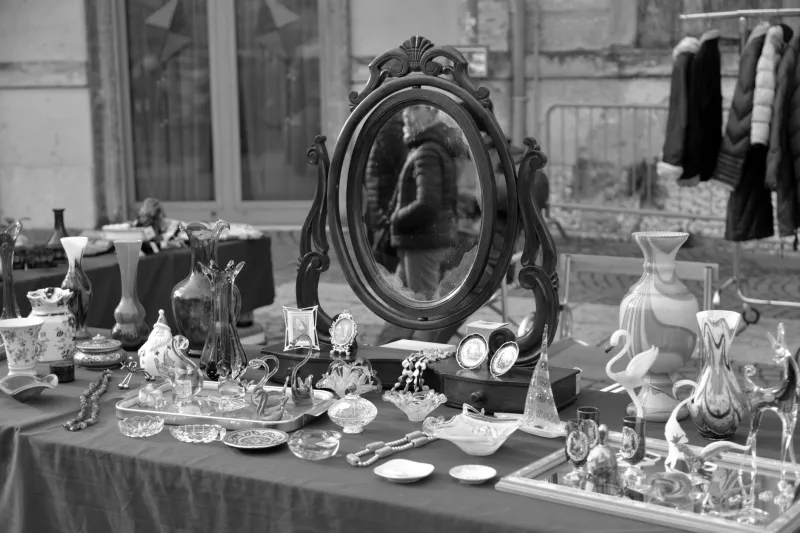
Ceramics with a mark on the base. Glassware with real weight and no clouding. Wooden chopping boards you can sand back to life in twenty minutes. Sheffield steel tools, chisels and hand planes that will outlast anything on a DIY aisle shelf. Lamps with decent shades and brass fittings, which are the single most overpriced object in new retail. Picture frames, always, because a good frame costs more than the print you'll put in it. Linen and cotton tablecloths, which are unkillable.
Leave behind: anything upholstered that smells, anything MDF that's swollen at the edges, matching sets of anything, 'collectibles' still in their packaging, and every single item you're buying because it's cheap rather than because you want it. That last one is how a home ends up looking like a car boot rather than furnished by one.
Making it look deliberate
Here's the styling bit, and it's simpler than the internet suggests. Edit hard. Three objects that mean something beat thirty that were merely available. Keep a colour thread running through the room — a muddy green, an off-white, a burnt orange — and let the car boot fill in around it.
Repair things properly. A rewire, a re-glue, a coat of beeswax. Care is the thing that separates a find from a jumble sale. Group the wonky mugs together so the wobble reads as a collection rather than a mistake. Put the £5 lamp somewhere it will actually be used, not on a shelf as a trophy.
And resist the urge to buy the whole look in one Sunday. The point isn't a finished room. It's a home that has clearly been assembled by a person with an eye and a free morning, which is a far rarer thing than a home that has clearly been assembled by a discount code.
Before you set the alarm
Take cash, a tote, a tape measure and a friend who will tell you the truth. Wear boots. Arrive early for the ceramics, stay late for the furniture, and don't haggle someone down to nothing on a £3 item — you'll feel it all week. Then drive home with a boot full of other people's history and the specific, unbeatable satisfaction of having chosen it all yourself.